
Just When You Thought It
Was Safe To Go Welding
The Green Smoke
Caper
by F.C. Tabor
Back in the late 1940's, I worked at a small machine shop in Sheridan, Oregon.
It was located in the heart of logging country, so the bulk of our repairs had to do with the lumber industry in one way or another.
We designed, built. manufactured and repaired sawmill equipment, all the way from trim saws to head rigs.
Our biggest manufactured product was sprockets.
I got a super education in acetylene burning by producing the circular plates for sprockets and gears.
I had an Ultra-Graph burning machine with which I could burn circular plates up to about 24 inches in diameter.
I burned a lot of sprocket and gear hubs from thick plate.
When I would cut one, I'd catch it with a pair of pliers and drop it on the floor to cool for handling in the following welding process.
My burning and fabrication area was right next to a large radial drill.
We would often get a circular saw from one of the local mills that required re-drilling of the arbor holes.
Now, here is something you probably never heard of unless you're a real old-timer, but one of the best lubricants for drilling high carbon steel is canned evaporated milk.
Since the stuff spoils rather rapidly, we never could carry over a can of it between jobs.
When the need arose, we went next door to a small grocery and got a can of Pet evaporated.
Now, the plot thickens . . .
A floor well about five feet deep was located within swing reach of the radial drill to accommodate tall jobs.
The top was recessed and covered with wooden planks to keep some sleepy welder or machinist from tumbling in.
In the course of drilling circular saws, the milk lubricant would naturally run down the side of the drill table and
a stream of it would meander over and soak into the wooden plank top of the drill well.
I did not suspect the dire consequences that would generate, until one day while I was burning out a batch of gear hubs from inch-and-a-half plate.
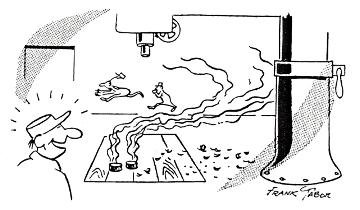
I tossed a hot one in the general direction of the floor. It lit, rolling, and traveled in a bee line over to the old milk-soaked planks on the drill well.
I became alert when I noticed a dirty dark green wisp of smoke curl up from the planks.
The wisp soon developed into a good imitation of the best Indian signal fire that ever sent a message.
This was only the mild appeal of the situation.
Suddenly, the stench of ancient, smoldering canned milk reached my nose.
To try to describe the odor would tax my vocabulary to the breaking point.
I can only say that if one could liquefy a hobo's toe jam and pour it on a pancake-griddle, you would probably
create a reasonable facsimile of the paralyzing stink that rose in the air.
About 50 feet from my station in the back corner of the shop, were two turret lathes.
Both operators broke records getting out the back door.
Naturally, upon being questioned later, I had no idea where the odor originated, but in time, everybody caught on.
When things got a little dull in the shop, I could always liven the situation up by heading a few hot gear hubs in
the proper direction.
* Originally published in Northwest Metalworker



Just When You Thought It
Was Safe To Go Welding
The Green Smoke
Caper
by F.C. Tabor
Back in the late 1940's, I worked at a small machine shop in Sheridan, Oregon. It was located in the heart of logging country, so the bulk of our repairs had to do with the lumber industry in one way or another. We designed, built. manufactured and repaired sawmill equipment, all the way from trim saws to head rigs. Our biggest manufactured product was sprockets. I got a super education in acetylene burning by producing the circular plates for sprockets and gears.
I had an Ultra-Graph burning machine with which I could burn circular plates up to about 24 inches in diameter. I burned a lot of sprocket and gear hubs from thick plate. When I would cut one, I'd catch it with a pair of pliers and drop it on the floor to cool for handling in the following welding process.
My burning and fabrication area was right next to a large radial drill. We would often get a circular saw from one of the local mills that required re-drilling of the arbor holes. Now, here is something you probably never heard of unless you're a real old-timer, but one of the best lubricants for drilling high carbon steel is canned evaporated milk. Since the stuff spoils rather rapidly, we never could carry over a can of it between jobs. When the need arose, we went next door to a small grocery and got a can of Pet evaporated. Now, the plot thickens . . .
A floor well about five feet deep was located within swing reach of the radial drill to accommodate tall jobs. The top was recessed and covered with wooden planks to keep some sleepy welder or machinist from tumbling in. In the course of drilling circular saws, the milk lubricant would naturally run down the side of the drill table and a stream of it would meander over and soak into the wooden plank top of the drill well. I did not suspect the dire consequences that would generate, until one day while I was burning out a batch of gear hubs from inch-and-a-half plate.
I tossed a hot one in the general direction of the floor. It lit, rolling, and traveled in a bee line over to the old milk-soaked planks on the drill well. I became alert when I noticed a dirty dark green wisp of smoke curl up from the planks. The wisp soon developed into a good imitation of the best Indian signal fire that ever sent a message. This was only the mild appeal of the situation.
Suddenly, the stench of ancient, smoldering canned milk reached my nose. To try to describe the odor would tax my vocabulary to the breaking point. I can only say that if one could liquefy a hobo's toe jam and pour it on a pancake-griddle, you would probably create a reasonable facsimile of the paralyzing stink that rose in the air.
About 50 feet from my station in the back corner of the shop, were two turret lathes. Both operators broke records getting out the back door. Naturally, upon being questioned later, I had no idea where the odor originated, but in time, everybody caught on. When things got a little dull in the shop, I could always liven the situation up by heading a few hot gear hubs in the proper direction.
* Originally published in Northwest Metalworker